
QR Code EN: Elfriede Schirrmacher
Text of the QR code on the memorial plaque · English version
Elfriede Schirrmacher
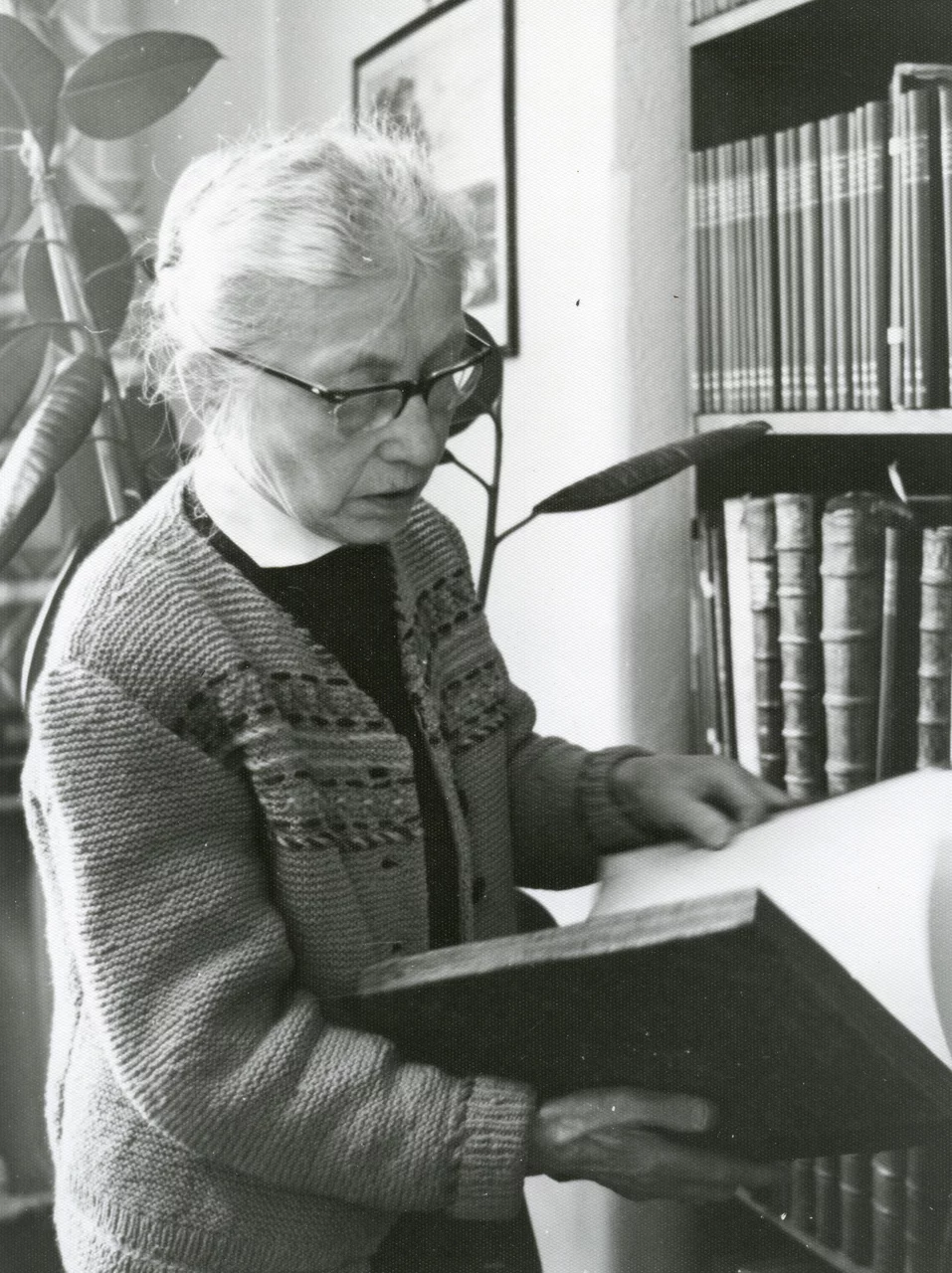
Elfriede Schirrmacher, um 1970, Foto: H.-W. Funk/ Stadtarchiv
Elfriede Schirrmacher was born in Kiel on 30 October 1894, the daughter of a Deckoffizier (warrant officer) in the Imperial German Navy. In 1903 the family moved to Frankfurt (Oder). From October 1916 she worked at the city library. Initially employed as an assistant in cataloguing, she continued her professional education in librarianship entirely through self-study, so that from 1923 she was entrusted with the Kleist Library of the Kleist Society. Her greatest achievement as a librarian, beginning in 1940, was the expansion of the scholarly local-history department into a special library on the history of the city and its university.
After Frankfurt (Oder) was declared a fortress city in 1945, Schirrmacher had to leave the city. She withdrew to Neuruppin, where she helped set up the library. In October 1945 she returned to the city on the Oder. In the summer of 1946 she was tasked with salvaging the records of the Prussian district government of Frankfurt (Oder) (Regierungsbezirk Frankfurt) and the courts. She soon extended the salvage work to the city's archival holdings. Their oldest parts, in particular the charters and deeds (Urkunden), had been stored in the strongroom of the destroyed town hall. The most recent archival records had remained in the tower stump of St Mary's Church and were largely lost. Further holdings had been relocated in 1944 to Crossen district (today Krosno Odrzańskie).
With effect from 1 May 1948, Schirrmacher was officially charged with rebuilding the city archive. In this context she completed an internship at the Berlin Main Archive (Berliner Hauptarchiv; the former Prussian State Archives) in Berlin-Dahlem. She continued her archival training at the German Central Archive in Potsdam, completing it with a diploma thesis on the reconstruction of the Frankfurt (Oder) City Archive and an overall grade of "very good".
In the building at Halbe Stadt 14a she brought together the salvaged records. The badly damaged and soiled archival materials had to be cleaned and restored. With great effort, Schirrmacher succeeded in securing funding for the restoration work and in finding workers. Because the associated finding aids had been lost, she had to re-arrange and catalogue the archival holdings from scratch. In painstaking detail work she reconstructed torn records.
From 1951, at her suggestion, the municipal council (Rat der Stadt) also transferred the historical picture collection and the scholarly local-history department of the library to the city archive. In 1952 the archive moved to the upper floor of the city library. As part of the city's 700th anniversary celebrations, the Kleist Memorial Site (Kleist-Gedenkstätte) she had founded was ceremonially opened on 12 July 1953. In 1962, part of the evacuated archival holdings, amounting to around 62 linear metres, returned from Poland. Here, too, the partly torn records had to be reconstructed and catalogued afresh. With the publication of the overview of holdings in 1972, the work was completed.
In recognition of Schirrmacher's tireless efforts on behalf of the city's documentary heritage, the municipal council (Rat der Stadt) and the city assembly (Stadtverordnetenversammlung) conferred on her in 1966 the title "Stadtarchivdirektorin" (City Archive Director). After the city archive moved in 1976 into the converted double parsonage on Collegienstraße, she retired after almost 58 years of service. She died on 15 November 1978 in Frankfurt (Oder).
Through the rebuilding of the city archive and the founding of the Kleist Research and Memorial Centre (Kleist-Forschungs- und Gedenkstätte), Elfriede Schirrmacher safeguarded the city's cultural heritage and made it accessible to the public. It is thanks to her that Frankfurt (Oder) today has one of the largest municipal archives and, in the Kleist-Museum – the successor institution to the memorial – an outstanding literary museum in the federal state of Brandenburg.
Dr Denny Becker, Director, Frankfurt (Oder) City Archive